Pearson Edexcel · GCSE · Biology
Course version: 1BI0 · Version from Sept 2016
Describe photosynthetic organisms as the main producers of food and…
Full specification wording
Topic 6 – Plant structures and their functions: 6.1 Describe photosynthetic organisms as the main producers of food and therefore biomass
Photosynthetic organisms sit at the base of almost every food chain because they make their own food.
Checked against the Pearson Edexcel 1BI0 specification (opens in a new tab) on .
- Point 1 of 15
- 4 key terms
Study notes
From the checked teaching notes for this specification point.
The idea
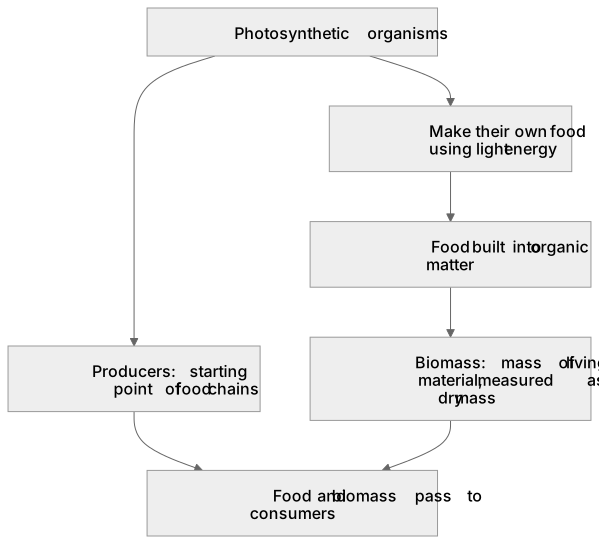
Photosynthetic organisms sit at the base of almost every food chain because they make their own food. Using light energy, they convert carbon dioxide and water into glucose, and this glucose is built into the organic matter that makes up their bodies. That organic matter is biomass: the mass of living material, measured as the dry mass of an organism once water has been removed. Because plants and algae manufacture food rather than consuming it, they are called producers, and the food and biomass they create pass to consumers along food chains. A useful method is to trace energy back: pick any consumer, follow its food source down the chain, and you reach a photosynthetic organism. Algae in ponds and crops in fields both illustrate the same principle.
What earns the marks
- Photosynthetic organisms make their own food using light energy rather than eating other organisms.
- The food they produce is built into organic matter, which constitutes their biomass.
- Biomass is the mass of living material, often measured as dry mass.
- Energy and matter pass from producers to consumers, so producers supply the food and biomass for the rest of the chain.
Common mistakes and how to put them right
Thinking producers eat small organisms.
Put it right by stressing that photosynthetic organisms manufacture food from carbon dioxide and water using light.
Confusing biomass with fresh mass including water.
Put it right by noting biomass is often measured as dry mass.
Believing consumers create their own biomass from nothing.
Put it right by explaining that consumer biomass ultimately derives from producer biomass.
Exam tips
- Link the term producer directly to making food by photosynthesis, not to size or habitat.
- When asked why plants are the main producers, mention food production leading to biomass.
- Use a food chain example to show energy passing from a producer to a consumer.
Try the lesson
The start of the Topic 6 – Plant structures and their functions: 6.1 Describe photosynthetic organisms as the main producers of food and therefore biomass lesson, made from checked teaching notes for this specification point.
Have a go first
Why are photosynthetic organisms described as the main producers of food in an ecosystem?
Listen
Photosynthetic organisms sit at the base of almost every food chain because they make their own food. Using light energy, they convert carbon dioxide and water into glucose, and this glucose is built into the organic matter that makes up their bodies. That organic matter is biomass: the mass of living material, measured as the dry mass of an organism once water has been removed. Because plants and algae manufacture food rather than consuming it, they are called producers, and the food and biomass they create pass to consumers along food chains. A useful method is to trace energy back: pick any consumer, follow its food source down the chain, and you reach a photosynthetic organism. Algae in ponds and crops in fields both illustrate the same principle. A strong answer earns marks for these points. Photosynthetic organisms make their own food using light energy rather than eating other organisms. The food they produce is built into organic matter, which constitutes their biomass. Biomass is the mass of living material, often measured as dry mass. Energy and matter pass from producers to consumers, so producers supply the food and biomass for the rest of the chain. A common slip: Thinking producers eat small organisms. Instead, stressing that photosynthetic organisms manufacture food from carbon dioxide and water using light. Exam tip: Link the term producer directly to making food by photosynthesis, not to size or habitat.
See it
Watch it explained
What is the one idea the video explains? Say it in a sentence.
Read the described scene instead
Photosynthetic organisms sit at the base of almost every food chain because they make their own food. Using light energy, they convert carbon dioxide and water into glucose. That glucose is built into organic matter, which makes up their bodies. The overall word equation for photosynthesis is carbon dioxide plus water, in the presence of light energy, produces glucose plus oxygen. The glucose is used to build organic matter, and that organic matter is biomass: the mass of living material. Biomass is often measured as dry mass after water is removed. Plants and algae are called producers because they are the starting point of food chains. The food and biomass they create pass to consumers along food chains. So producers supply the food and biomass for the rest of the chain. Here is a useful method: trace energy back. Pick any consumer, follow its food source down the chain, and you reach a photosynthetic organism. Pause and think: in a pond, if a consumer eats an organism that eats algae, what is the producer? Follow the food source back: the organism eats algae, so algae are the producer. Consumer biomass ultimately derives from producer biomass. One common mistake is thinking producers eat small organisms. Photosynthetic organisms manufacture food from carbon dioxide and water using light. Another mistake is confusing biomass with fresh mass including water; biomass is often measured as dry mass. A third is believing consumers create their own biomass from nothing. Consumer biomass ultimately derives from producer biomass. Photosynthetic organisms are the main producers of food, and therefore biomass. They make food by photosynthesis, building organic matter that is measured as dry mass. That food and biomass pass from producers to consumers along food chains, so producers supply the food and biomass for the rest of the chain.
Key words
Say what each word means before you turn the card.
Producers
Try answering aloud or in your head before turning the card.
Photosynthesis
Try answering aloud or in your head before turning the card.
Biomass
Try answering aloud or in your head before turning the card.
Food chains
Try answering aloud or in your head before turning the card.
See every definition
- Producers
- Photosynthetic organisms that make their own food using light energy rather than eating other organisms, and are the starting point of food chains.
- Photosynthesis
- The process in which carbon dioxide and water are converted into glucose using light energy, so that organisms manufacture food rather than consuming it.
- Biomass
- The mass of living material, measured as the dry mass of an organism once water has been removed.
- Food chains
- The route along which the food and biomass created by producers pass to consumers.
Label the diagram
Some boxes have lost their names. Pick the right name for each number.
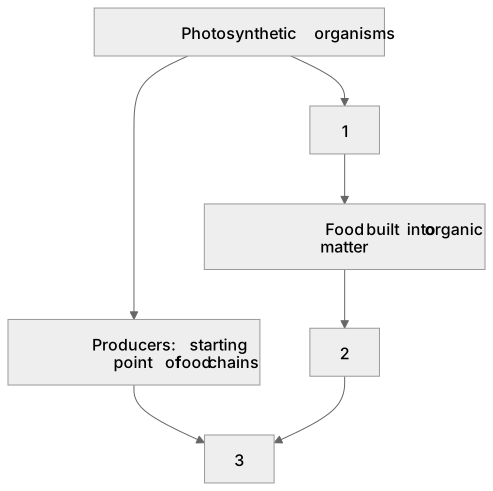
1Box 1
2Box 2
3Box 3
There is more to this lesson
The full lesson goes on to check your understanding and help you earn the marks. Create a free account to carry on, with your progress saved.
A week of Premium from your first lesson · Then the free plan continues · No card, no charge
Test your understanding of Topic 6 – Plant structures and their functions: 6.1 Describe photosynthetic organisms as the main producers of food and therefore biomass
Active recall beats re-reading. Take an instant quiz now to test what you’ve learned and lock it into long-term memory.
A week of Premium from your first lesson · Then the free plan continues · No card, no charge